Showing posts with label truth. Show all posts

Tuesday, January 28, 2025

Ministry of Truth Daily Update - 28 Jan 2025 - Meta Defectors


Meta Defectors

In a stunning betrayal of Big Brother and the Ministry of Truth, major media outlets announced that they will no longer use "biased" fact-checkers.  They are abandoning Ministry approved truth moderators and are opening themselves up to abuse by purveyors of misinformation and hate speech.  We will remember these defections.

More info: 

Newspeak Dictionary Recent A-L M-Z FAQ

Sunday, December 1, 2024

Apologetics 101 - Christian Case-Making - Can We Trust the Bible?

Christian Case-Making
in a Modern World

Apologetics 101

Can We Trust the Bible? 

Is the Bible more than just an old collection of stories and sayings about God and morality? Is there reason to trust that this document is important enough to put my eternal fate in its teachings? As we will see, yes, there are good reasons to trust that the Bible is actually the inspired Word of God.

Challenges

Skeptics are quick to assume that the Bible is nothing more than a man-made creation.

  • According to Bill Nye, we should not trust some ancient text that has been re-translated many times, over thousands of years, into American English. (2014 Creation Debate) 

  • Jesus never claimed to be God and his disciples misunderstood what he taught.

  • Over the centuries legends and myths were added to the Bible.

  • The Bible is just a book written by imperfect men with an agenda.

  • The Gospels were written long after the events described and not by any eye witnesses.


But are these assertions actually true or not?


Future blogs will dig further into topics such as:

  • Reliability and Authority of Scripture

  • Is the Bible accurate in all of its teachings? 

  • Biblical Inerrancy vs. infallibility (the ICBI statement)


But for now, let's consider how we got the NT writings, and whether or not what we have accurately reflects the beliefs and teachings of Jesus and his disciples.

Historical Reliability of the Gospels
 

This is an image of P52 - a fragment of John dated at 100-150 A.D.


  • The NT documents are the best attested documents of antiquity in terms of total number of manuscripts. For example, there are 10X more than the runner-up, Homer.

    • About 1000 times more than average Greco-Roman author: 5800+ Greek manuscripts, 10000+ Latin/other, million+ quotes from church fathers - While some are a verse or 2, the avg. size of a NT manuscript is 450 pages!

  • The interval of time between the original authorship and the date of the earliest NT manuscript copies is extremely short.

  • The historic statements made about Jesus by ancient non-Christian authors fit well with the Gospel record.

  • The authors of the four Gospels were either eyewitnesses of Jesus’ life themselves, or were closely associated with eyewitnesses.

  • The Gospel writers intended to convey (and were capable of conveying) historical and factual information about Jesus, and the historical content of their writings has been confirmed to a significant degree.

  • The apostles credibility as truth-tellers is greatly strengthened when one recognizes they had little to gain and almost everything to lose in proclaiming Jesus as Lord and Savior.

Early Dating of the Gospels

There are good reasons to believe that the Gospels were written within the lifetime of eye-witnesses to the events of Jesus' life.  Apologist J. Warner Wallace has an excellent analysis of this and concludes that the evidence shows that the gospels likely were written prior to 55 A.D.  One line of evidence is from apparent quotes of Luke's writings by Paul (between 48-60 A.D.).  For example:

Luke's Gospel says:

And when He had taken some bread and given thanks, He broke it and gave it to them, saying, “This is My body which is given for you; do this in remembrance of Me.” And in the same way He took the cup after they had eaten, saying, “This cup which is poured out for you is the new covenant in My blood.”  (Luke 22:19-20)


While Paul says:

For I received from the Lord that which I also delivered to you, that the Lord Jesus in the night in which He was betrayed took bread ; and when He had given thanks, He broke it and said, “This is My body, which is for you; do this in remembrance of Me.” In the same way He took the cup also after supper, saying, “This cup is the new covenant in My blood…   (1 Cor. 11:23-26) (written 53-57 A.D.)


Hence, Luke's gospel (or at least a common source) was in existence before Paul wrote his letters.  Similar arguments can be made for the other gospels as well.  Even John can reasonably be viewed as having written Revelation prior to the destruction of the Temple in 70 A.D.

Myth or Fact?

  1. Because of the early emergence of the Gospels, and the sources behind them, myths and legends did not have sufficient time to develop and be recorded in their accounts.

  2. The theory that the Gospels are myth is only plausible if several generations existed over which mythology concerning Jesus could grow.

  3. The apostles of Jesus recognized the difference between myth and factual eyewitness testimony, and they solemnly asserted that they were eyewitnesses of historical events.

  4. If the Gospel writers had departed from historical fact (either by exaggeration or outright invention), hostile witnesses familiar with the events of Jesus’ life could have exposed them.

  5. The Gospel stories do not correspond in style or in content with other known mythical writings.

  6. The arguments for rejecting the Gospels as history are circular.  (E.g. anti-supernatural bias and presuppositions)


In his book, Cold-Case Christianity, J. Warner Wallace shows that we have good reason to trust that the Bible faithfully records what the disciples originally wrote.  He does this by showing the "Chain of Custody" for three lines of teaching: 

  1. (John) Mark (an associate of Peter) - author of the Gospel of Mark

  2. The Apostle John - author of the Gospel of John, and the Book of Revelation

  3. The Apostle Paul - wrote many books/letters of the New Testament


All three of these can be traced through writings and quotations from early church fathers up through 350 A.D. and beyond, where we have the Codex Sinaiticus and the Council of Laodicea.  So we have confidence that what we have today is actually what they taught and believed about Jesus.

What About the OT?

  • The 39 books of the OT consist of Hebrew writings, broadly: The Law of Moses, Books of History, The Major/Minor Prophets, and the Poetry and Wisdom books.

  • Jesus affirmed the OT as coming from the mouth of the Lord.

  • Paul viewed these as the very words of God.

  • So, if we have good reason to believe what the NT has to say about Jesus, then we can also be confident of the OT documents as well.

Takeaways

  • There are good reasons to trust the reliability of the NT documents.

  • If we can trust what they say, then we have good reason to trust what they say about Jesus.

  • If we can trust what they say about Jesus, then we have to deal with the implication of a man who claimed to be the Son of God.

Recommended Resources


Sunday, November 24, 2024

Apologetics 101 - Christian Case-Making - What in the World is a Worldview?

Christian Case-Making
in a Modern World

Apologetics 101

What in the World is a Worldview? 

A worldview is a set of beliefs and practices that shape a person’s approach to the most important issues in life.  It is the interpretive lens/glasses/prism through which you see life.  It guides your life's direction and grounds your ultimate concerns and values.  A good worldview gives answers to the "Big Questions of Life". 

The Big Questions of Life

A good worldview gives answers, or guides our search.
  • What kind of God, if any, actually exists?
  • Is there anything beyond the cosmos?
  • What can be known and how can anyone know it?
  • Where did I come from?
  • Who am I ?
  • Where am I?
  • How should I live?
  • What should I consider of great worth?
  • What is humanity's fundamental problem?
  • How can humanity's problem be solved?
  • What is the meaning and direction of history?
  • Will I survive the death of my body and, if so, in what state?

Where Does Our Culture Stand?

Sadly, as we will see, most people do not even hold the foundational truths of Christianity to be true anymore. In the first national study since the 2020 pandemic, the Barna Group did a worldview survey with some surprising results. Sadly, those holding to a Christian worldview have dwindled even further.

Defining a Christian Worldview

  • Believing that absolute/objective moral truth exists and can be found in the Bible.
  • The Bible is accurate in all it teaches
  • Satan is considered to be a real being or force, not merely symbolic
  • A person cannot earn their way into Heaven by trying to be good or do good works (i.e. salvation is a gift from God)
  • Jesus Christ lived a sinless life on earth
  • God is the all-knowing, all-powerful creator of the world who still rules the universe today
  • Christians have a duty to share their faith in Christ with other people.

Some Surprising Results (as of 2023)

  • While 68% of Americans still self-identified as Christians
    • Only 4% of all American adults have a biblical worldview. Barna calls this an Integrated Disciple.
    • Only 14% of all American adults even hold to a "substantial number of beliefs and behaviors" consistent with a biblical worldview. (i.e. an Emergent Follower)
    • Most Americans (82%) generally believe and act in ways that are distinct from biblical teaching. (i.e. a World Citizen)
  • Virtually every demographic category has seen significant declines, including "born-again Christians", who are down 6% to 13% holding a biblical worldview. This group is defined as believing they will go to heaven when they die, but only if they confess their sins and accept Jesus as their Savior.
  • Young people are very isolated from biblical beliefs, and unsurprisingly are the most aggressive in opposing and rejecting those principles in culture, politics, and laws. Age is a consistent factor in correlating Christian beliefs.
  • Interestingly, formal education showed little correlation to having a Christian worldview, though there was a slight trend upward for those who finished college over those who didn't.
  • With respect to politics, those who are consistently 
    • Conservative - 12% are Integrated Disciples
    • Moderate - 2% have a biblical worldview
    • Liberal/progressive - 1% have a biblical worldview

Other Common Worldviews

Obviously, the Christian worldview is not the only one.  But when looking to build yours, you need to compare and contrast it with opposing beliefs, examining the explanatory power and scope.  In other words, which one gives the best overall explanation of reality.  Others include:
  • Naturalism - the philosophical belief that everyone and everything in the universe has a physical cause and that there is no supernatural or spiritual reality.
  • Post-modernism - this is grounded in the idea that there is no objective truth, at least that can be known (i.e. it embraces subjective or relativistic truth).   It is very skeptical of grand narratives and is sometimes called the worldview that rejects all worldviews. 
  • Pantheism - the belief that God is everything and that everything is God.  We are God but don't realize it.
I hope to cover some of these, and possibly others, in depth at a later point. 

Worldview Tests

When considering, or testing, a worldview, here are a few ways to approach it:
  • Is it logically consistent? Does it make sense?
  • Does it have a good balance of explanatory power and scope, without being overly simplistic or unduly complex?
  • Does it actually match our understanding of reality, both physically and spiritually?
  • Is it testable?  Is there good evidence for or against it (even in principle)?
  • Is it liveable in actuality?  

How do I Build a Christian Worldview

Objective Truth matters. A worldview based on moral relativism has no foundation. Beliefs have a direct impact on people's behavior and lifestyles.

Discovering Truth

Truth is something we should all seek. It can be discovered or known. Unlike the Postmodern worldview, the Christian worldview holds that reality is "out there", and that truth is not simply relative to the person and that it is knowable. That does not mean, however, that we can exhaustively know everything, even if it is theoretically knowable. And we can actually come to wrong conclusions, and be wrong, so humility is required too. Before you start your search for Truth, you should ask yourself whether or not you are willing to follow the evidence wherever it leads. If your biases are such that you will reject the evidence or refuse to give honest consideration to the facts, then you might as well not bother. Regardless of their starting worldview, the truth seeker will at least consider the evidence from the viewpoint of those holding opposing views. Willful ignorance or stubborn insistence on being "right" will be a stumbling block to the search for truth. Most people would agree that all people have dignity and worth. The Christian worldview grounds this belief in the fact that we are created in the Image of God, and thus have inherent value. However, it is a fallacy to assume that because of this status, criticizing the actions of a person or challenging their deeply held beliefs is out of bounds.

Relational Discipleship

It is not good enough to just gather knowledge.  Rather we need to be trained to be able to answer the tough worldview questions for ourselves and others.  When people can connect the dots between their core beliefs, then they have a firm foundation for building out their worldview.  Integration of worldview beliefs into daily lives and interactions with others is paramount.  This is best done in a small group, or one on one, environment.

Reject Relativism

At the root, this is a worldview issue.  Embracing a relativistic view of morality greatly influences one's actions, politics, and beliefs.   Under relativism, morality is defined by either the self, groups, or the broader culture.  There can be no objective set of moral standards with regards to sexuality, personal behavior, or social interactions.

Is there any common ground?  Because this is a war of worldviews, it is hard.  If one side cannot agree with the other that truth even exists, or can be discovered, then what common truth can be agreed upon?  When the moral relativists can't even justify why human beings have intrinsic dignity, value, and worth, how can that become a grounding principle?  The Christian worldview recognizes the inherent dignity and moral worth of all human beings, from beginning of life to the end, because we are all created in the Image of God.  We are all broken because of our rebellion against our Creator, but we are valuable regardless of how we have fallen.

For example, if a definition of "justice" makes distinctions between people, especially in the Church, based principally on classes they belong to (e.g. race, sexual identity, legal status, wealth/social status, historical oppressed/oppressor groups, or other intersectionality), then it is not based on the Christian worldview and is not biblical justice.  This view of identity is not compatible with the biblical worldview.  All people in the Church need to be held to the same biblical standards of morality, and exceptions should not be made based on their identity or supposed victimhood status.  

Takeaways

  • People act as they believe (i.e. their worldview).
  • A worldview is how a person, or even a culture, views reality and their place in it.
  • Influences from entertainment, government, media, and education have a strong impact.
  • Worldviews are best developed in relationships with others, where honest questions can be asked and answered.  

Recommended Resources


Sunday, October 27, 2024

Apologetics 101 - Christian Case-Making - The Historical Jesus and The Resurrection


Christian Case-Making

in a Modern World

Apologetics 101

The Historical Jesus and The Resurrection

Most people have a positive view of Jesus.  Some view him as a good moral teacher, while others make claims of miracles, sinlessness, and actual deity.  But was Jesus a mythological figure or did he actually live and walk among us about 2000 years ago?  Was he just a crazy person with delusions of godhood?  Was he a unique man of integrity and wisdom about whom tall tales are told after the fact?  Wasn't he a rebel Jewish rabbi with dedicated disciples, who was often misunderstood but never claimed to be God?  Or is it possible that he actually claimed to be God in human form? 

Skeptics Say

Many people have objected to the claims that Christians make about the historical Jesus.

  • Jesus didn’t even exist; he is just a legend. 

  • Jesus never claimed to be God and his disciples misunderstood what he taught.

  • Dead people stay dead.  It was all an elaborate hoax made up to control people.

  • The Gospels were written long after the events described and not by any eyewitnesses.

  • The Bible was put together for political and doctrinal reasons, leaving out dissenting views.


In this post, we'll sketch out some of the evidence for who Jesus was, what he claimed, and how we can have confidence that it is true.  We will make the case that the best explanation of the evidence is that Jesus Christ was the unique Son of God, who became a man, was crucified, and then resurrected from the dead. 

Can We Trust the NT Accounts?

There are good reasons to trust the reliability of the NT documents and what they say about Jesus.  We have the following:

  • Manuscript evidence (far superior to others in terms of number, quality, and dating)

  • Non-Christian witnesses/authors wrote about Jesus and Christianity too

  • Early church writings show consistency in teaching with the New Testament (NT) writings

  • The Gospels appear to be reporting eyewitness testimony (and they explicitly make that claim)

  • Historical accuracy verified by discoveries in archeology, science, and other historical records

  • Motive - writers had little to gain and much to lose

  • Myth and legends require time to develop that is simply not an option here.

Abundance of Manuscript Evidence

There are about 1000 times more ancient manuscripts than the average Greco-Roman author: 

  • 5800+ Greek manuscripts

  • 10000+ Latin/other

  • million+ quotes from early church fathers

While some are just a verse or two, the average size of a NT manuscript is 450 pages!

Historical Reliability of the Gospels

  1. The NT documents are the best attested documents of antiquity in terms of total number of manuscripts (10 times more than the runner-up, Homer).

  2. The interval of time between the original authorship (the autographs) and the date of the earliest NT manuscript copies is extremely short.  

    1. P52 - fragment of John dated 100-150 A.D.

    2. Discoveries of Luke (P75 - 175-225 AD) fragment & Mark P5345 (2nd-3rd century)

Obviously the originals had to have been written and copies circulated before these dates.

  1. The historic statements made about Jesus by ancient non-Christian authors fit well with the Gospel record.  These include Tacitus (55-120 AD), Suetonius (120 AD), Josephus (37-97 AD), Pliny (112 AD), Jewish Talmud (2nd Century AD and on), ...

  2. The authors of the four Gospels were either eyewitnesses of Jesus’ life themselves, or were closely associated with eyewitnesses.

  3. The Gospel writers intended to convey, and were capable of conveying, historical and factual information about Jesus, and the historical content of their writings has been confirmed to a significant degree.

  4. The apostles’ credibility as truth-tellers is greatly strengthened when one recognizes they had little to gain and almost everything to lose in proclaiming Jesus as Lord and Savior.

Dating the Gospels

The book, Cold Case Christianity, by J. Warner Wallace, is a great resource for making the case for the historicity of the Gospels and Christianity.  This is a infographic from the book that shows some of the probable dates of various gospel writings in relation to the lifetime of Jesus.  The conclusion is that the gospels and Paul's writings were all created within the lifetime of the eyewitnesses and apostles.
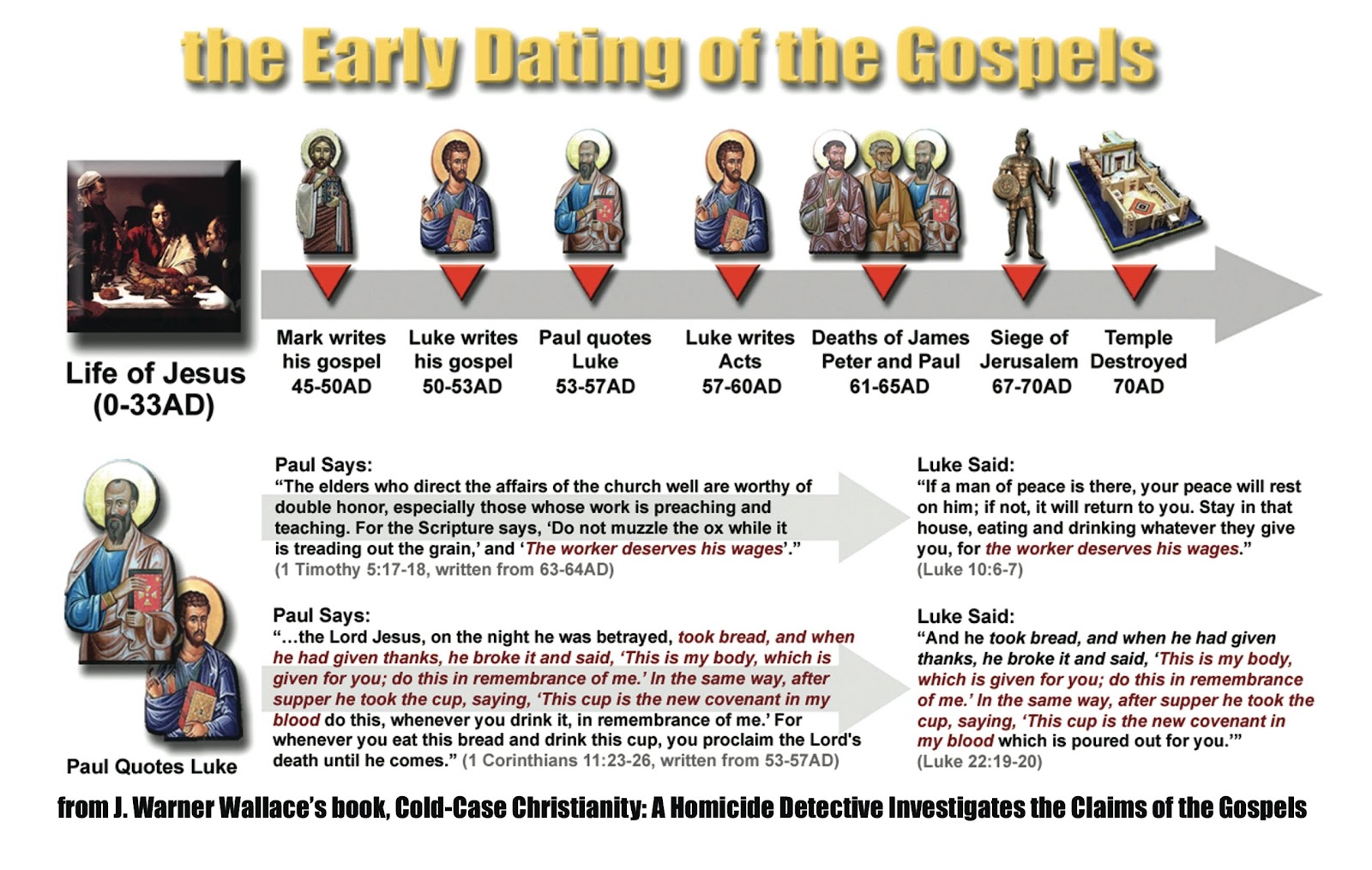
Early Dating Insert

Let's Play "Myth or Fact?"

MYTH - The Gospels are just exaggerated stories and legends.   

FACT - Because of the early emergence of the Gospels and the sources behind them, myths and legends did not have sufficient time to develop and be recorded in their accounts.

FACT - The theory that the Gospels are myth is only plausible if several generations existed over which mythology concerning Jesus could grow.

FACT - The apostles of Jesus recognized the difference between myth and factual eyewitness testimony, and they solemnly asserted that they were eyewitnesses of historical events.

FACT - If the Gospel writers had departed from historical fact (either by exaggeration or outright invention), hostile witnesses familiar with the events of Jesus’ life could have exposed them.


MYTH - The Gospel stories correspond in style and in content with other known mythical writings.

FACT - The arguments for rejecting the Gospels as history are circular.  (E.g. anti-supernatural bias and presuppositions)

Have the Contents Changed?

So how do we know that the contents of the original teachings have made their way to us?  Like any good criminal case, there is a chain of custody that documents who is handling the evidence.  Again, J. Warner Wallace shows that we have three different chains of custody from the apostles to many early church fathers to the council of Laodicea (350-363 AD).  He traces these three:  Peter, John, and Paul.  It is clear that the church consistently taught (from the beginning) the deity of Jesus Christ, his miracles and teachings, and ultimately his death, burial, and resurrection.
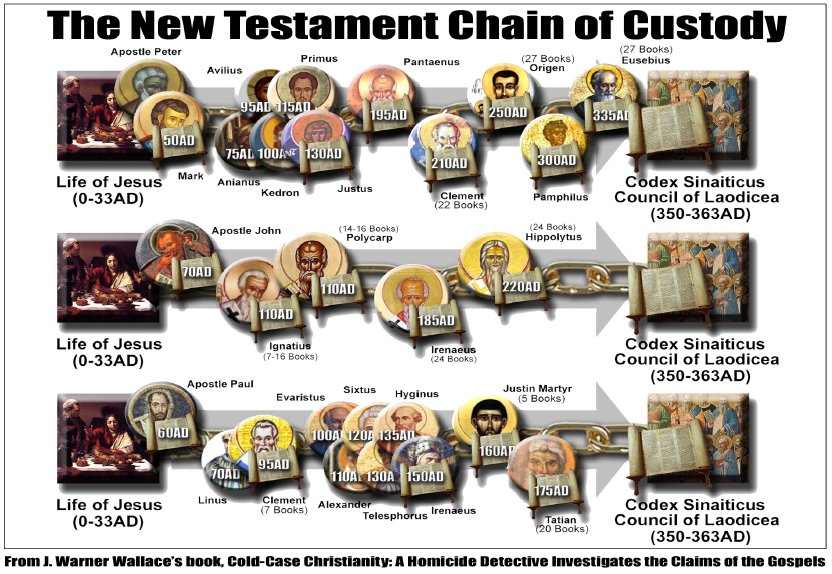
NT Chain of Custody


Did Jesus Really Think That He Was God?

Skeptics have sometimes claimed that the disciples put claims into the mouth of Jesus that he never intended, but is that actually true?  What did Jesus consistently teach and was that in line with the understanding of his followers?


C.S. Lewis famously said that Jesus was either "Lord, Liar, or Lunatic".  To put it another way, was Jesus

  • Man

  • Myth

  • Madman

  • Menace

  • Mystic

  • Martian

  • Messiah


How do these options stack up against each other?  Here are some proposed explanations:

  1. Jesus’ followers placed the Messianic claim in his mouth long after the fact.  Thus Jesus’ claims to divinity are mythical. 

  2. Jesus was simply a “great man,” even a “great teacher,” but he was not God.

  3. Jesus claimed to be the divine Messiah, but knew he was not.  He was, therefore, an intentional deceiver and thus an evil menace.

  4. Jesus thought he was the divine Messiah, but was not.  He was a delusional psychotic, a madman.

  5. Jesus claimed to be divine, but meant it in an Eastern mystical sense that “all human beings are divine.”  He was therefore a mystical guru.

  6. Jesus claimed to be God, but in actuality was a “Martian,” that is, an extraterrestrial.

  7. Or maybe Jesus actually was the divine Messiah! 


Again, “What’s the best explanation that fits the facts?"

Jesus equated himself with the Father (Yahweh God).

  • To know Jesus is to know God (John 14:7) 

  • To see Jesus is to see God (John 14:9)

  • To encounter Jesus is to encounter God (John 14:11)

  • To trust in Jesus is to trust in God (John 14:1)

  • To welcome Jesus is to welcome God (Mark 9:37)

  • To honor Jesus is to honor God (John 5:23)

  • To hate Jesus is to hate God (John 15:23)

  • To come to Jesus is to come to God (John 14:6)

  • To love Jesus is to love God (John 14:21)

  • To obey Jesus is to obey God (John 14:23)

Jesus made direct claims that many Jewish religious leaders considered blasphemous.

  • “… making himself equal to God” (John 5:18)

  • Jesus often said “my Father”, not just “our Father”, implying a special relationship

  • Said he was the “I AM” (i.e. YHWH) (John 8:58-59)

  • “I and the Father are One” (John 10:30-33)

  • “Are you the Christ?”  -- “I am”.  They called it blasphemy (Mark 14:61-64) because he affirmed he was Israel’s Messiah, called himself by the divine title of “Son of Man”, and said he would return in judgment of them and be sitting at God’s right hand.

Jesus indirectly claimed to be God by invoking divine prerogatives.

  • Forgive sins (Mark 2:5-7)

  • Received worship (Matt. 28:16-17)

  • Claimed power and authority over death and life (John 5:21)

  • Authority to judge humanity (John 5:22,27)

  • Prayers and requests in his name will be granted (John 14:13-14)

Jesus claimed to be God by invoking various divine titles.  

These included 

  • both "Son of God" and "Son of Man" 

  • Lord of the Sabbath: Jesus claimed authority over the Sabbath. 

  • Light of the World: Jesus said, "When I am in the world, I am the Light of the World". 

  • Bread of Life: Jesus said, "I am the bread of life: he who comes to me shall not hunger". 

  • Way, Truth, and Life: Jesus said, "I am the way, the truth, and the life. No one comes to the Father except through Me".    

The Resurrection

A key piece of evidence to consider is based on the Resurrection event.  This is an extraordinary claim.  If true, it sets Jesus and Christianity apart from all other religions.  Scientifically, and based on our common experience, there is no way that a really, truly dead person can come back to life without divine intervention!

But, "C'mon, man!"

Can anyone really believe that a dead person actually came back to life?

  • All the accounts vary, so they can’t be believed.  They are filled with contradictions.

  • Miracles can’t happen.  It cannot be confirmed or tested.

  • People want to believe it’s true and irrationally hold to impossible tales.

  • The Shroud of Turin was shown to be a Middle Ages forgery by C-14 dating (or maybe not)

Why the Resurrection Matters

  • Validates Jesus’ Claims

  • Hope for our dead in Christ

  • Eternal future with imperishable bodies

  • Motivates us to share this good news

  • Disprove the resurrection and Christianity falls apart, being just another false religion


The apostle Paul said,

Now if Christ is proclaimed as raised from the dead, how can some of you say that there is no resurrection of the dead? 13 But if there is no resurrection of the dead, then not even Christ has been raised. 14 And if Christ has not been raised, then our preaching is in vain and your faith is in vain. 15 We are even found to be misrepresenting God, because we testified about God that he raised Christ, whom he did not raise if it is true that the dead are not raised. 16 For if the dead are not raised, not even Christ has been raised. 17 And if Christ has not been raised, your faith is futile and you are still in your sins.18 Then those also who have fallen asleep in Christ have perished. 19 If in Christ we have hope in this life only, we are of all people most to be pitied.  1 Corinthians 15:12-19

Reasons to Believe the Resurrection

  • The Empty Tomb

  • The Post-crucifixion Appearances

  • The Transformation of the Apostles

  • The Conversion of Saul → Paul

  • Emergence of the Christian Church

  • A switch to Sunday as a day of Worship

Gospel Resurrection Accounts 

  • Matthew 27:57-66; 28:1-15

    • Burial in rich man’s tomb, guarded, sealed tomb, linen shroud, earthquake, stolen body

    • Pilate, Joseph of Arimathea, Mary Magdalene and other Mary, angel of the Lord, Jesus

    • Women saw Jesus put into tomb, so they knew where it was

    • Jews were worried that Jesus said he would rise after 3 days

    • Appeared to the Mary’s and the eleven disciples

  • Mark 15:42-47; 16:1-8

    • Burial in tomb, linen shroud, very large stone, spices, empty rock tomb, centurion verified Jesus was dead, women fled the tomb but not believed

    • Pilate, Joseph of Arimathea, Mary Magdalene and Mary the mother of Joses (they saw the burial), Mary mother of James, Salome, “young man” (angel)

  • Mark 16:9-20 (long ending – missing from earliest mss)

    • Mary Magdalene saw Jesus, but not believed

    • Appeared to 2 disciples as they walked in the country, but not believed

    • Jesus appeared to the eleven, gives Great Commission

  • Luke 23:50-56; 24:1-53 

    • New stone tomb, linen shroud, prepared spices and ointments, stone rolled away, body gone

    • Pilate, Joseph of Arimathea, the women (including Mary Magdalene, Joanna, Mary mother of James), two “men” (angels), 2 disciples (including Cleopas) on road to Emmaus

    • Women saw the tomb and how Jesus’ body was laid in it.  They went to prepare spices and ointments for later.

    • Disciples didn’t believe the women’s “idle tale” until he appeared to them (the eleven)

    • Peter saw the linen cloths by themselves.  Jesus appeared to Simon Peter.

    • Jesus showed his hands and feet – he had flesh and bones.

  • John 19:38-42;20:1-31 

    • Bound Jesus’ body in ~75 lbs of myrrh and aloes with linen cloths – according to Jewish custom, new garden tomb, stone rolled away, body gone, empty cloths, face cloth folded

    • Pilate, Joseph of Arimathea, Nicodemus, Mary Magdalene, Peter and “the other disciple” (John), 2 angels

    • Peter and John saw the empty tomb and cloths

    • Jesus appears to Mary and the disciples (once w/o Thomas)

  • 1 Corinthians 15:1-19 

    • Christ died for our sins

    • Buried and raised the 3rd day

    • Jesus Appeared to 

      • Cephas (Peter) 

      • The Twelve

      • Over 500 at one time (you can still go ask some of them)

      • Saul/Paul 

    • If the resurrection didn’t happen our belief is in vain and we should be pitied


"The evidence for the resurrection is better than for claimed miracles in any other religion.  It's outstandingly different in quality and quantity."  Antony Flew, Famous Skeptic who wrote There is a God: How the World's Most Notorious Atheist Changed His Mind

Minimal Facts Approach

What facts do virtually all NT scholars -- even the skeptical, non-Christian ones – consider to be historically reliable?  

  1. Jesus died by crucifixion.

  2. Jesus’ tomb was empty after his burial.

  3. Jesus’ disciples sincerely believed He rose from the dead and appeared to them.

  4. Paul, the church persecutor, converted and began preaching about the risen Jesus.

  5. James, the skeptic (and brother), converted and began preaching about the risen Jesus.


What is the best explanation for even this limited set of facts?

Alternate Explanations

  • The resurrection is just a legend or myth created many years after the fact.

  • The disciples stole the body and created an elaborate hoax.

  • Christians just made it up to control people.

  • Jesus didn't even exist; he is just a legend.

  • The women went to the wrong tomb.

  • The Romans disposed of his body in a mass grave.

  • Jesus was only “mostly dead” and then revived later.

  • The disciples simply hallucinated that they saw him alive after His death.

  • Jesus was impersonated (by a twin?)


A common thread to all of these theories is a belief that a supernatural event could not have happened!

In Defense of the Resurrection

  • If Jesus’s body was still in the tomb, wouldn’t his followers pilgrimage to that location, as the Muslims do today?

  • Consider the disciples.  They had very little to gain and much to lose by continuing to preach a risen Jesus in the face of intense persecution.  

  • Conspiracies are very hard to maintain, especially with large numbers of people who know it to be a lie.  Yet none of them cracked.


“… no intelligent jury in the world could fail to bring in a verdict that indeed the resurrection story is true.”  Lord Darling, former Chief Justice of England


“It was the evidence from science and history that prompted me to abandon my atheism and become a Christian.”  Lee Strobel, Christian Apologist


The best explanation that fits all the facts is that Jesus was crucified, was buried, and then rose again!


If Christ is risen, nothing else matters. And if Christ is not risen – nothing else matters.”
    Jaroslav Pelikan


Christianity, if false, is of no importance, and if true, of infinite importance, the only thing it cannot be is moderately important.  C.S. Lewis

Takeaways

  • There are good reasons to trust the reliability of the NT documents.

  •  If we can trust what they say, then we have good reason to trust what they say about Jesus.

  •  If we can trust what they say about Jesus, then we have to deal with the implication of a man who claimed to be the Son of God.

  • If true, this is of utmost importance, since the Son of God has called us to follow him.

  • Given all of the evidence, the best explanation is that Jesus was a historical person who lived about 2000 years ago.  He claimed to be God, and proved it by his resurrection.

Recommended Resources


More Apologetics Topics